
Is colored cork eco friendly? Yes! In the forefront of the building materials revolution, cork is one of the greenest alternatives there is. It is a naturally harvested material from the cork tree. It is harvested only from the bark of the cork oak tree, which means the tree keeps on living and helping to clean our air. It is one of the most highly renewable and eco-friendly resources on the planet.
Does bulletin board cork come in standard colors? Yes, we offer 15 Standard Stock Colors of cork “off the roll” 48″ wide material.
Can My Cork board be painted? Yes, it sure can! You can paint a uncolored cork board any color you choose….or multiple colors for that matter.
Can I get bulletin board cork in continuous full rolls, by the square yard or cut to size? Yes, all 3. We offer the continuous 48″ wide material in the 15 colors and the 72″ wide in 4 colors. The material is 1/4″ thick, jute backed standard pinnable and sackable surface colored cork. We also cut pieces to size. Pricing is available in the Cork Calculator or as we like to say — Corkulator.
What do I use to apply cork? Adhesive with a trowel can be used.
How do I apply adhesive to cork? Apply adhesive with a 1/16″ notched trowel. the material comes off the roll, it has a natural curl to it and the wall adhesive does a good job of holding down the curl since it is SO sticky. It’s also a good idea to allow cork sheets to relax before installation to let the edges uncurl a bit. This helps keep the cork from wanting to pull away from the adhesive. Watch this video for “how to”.
What do I need to know about cutting & trimming cork? If cutting multiple pieces to be seamed for a wall, cut pieces of Bulletin Board to the required length and width, adding 2” – 3” in each direction to allow for final trimming. It’s a good idea to cut material 24 hours prior to installation. Also when planning the layout, allowing for a minimum of 1/2” – 3/4” of the factory edge to be trimmed from each side of the material for seaming is recommended. It’s also important to note that seams should fall a minimum of 6” away from joints in the substrate.
How can I install cork in my space? The typical ways would be to directly apply to a wall with adhesive or mount in a frame; which can be wood, aluminum or any other material you choose. We offer custom wood and aluminum frames in any size .
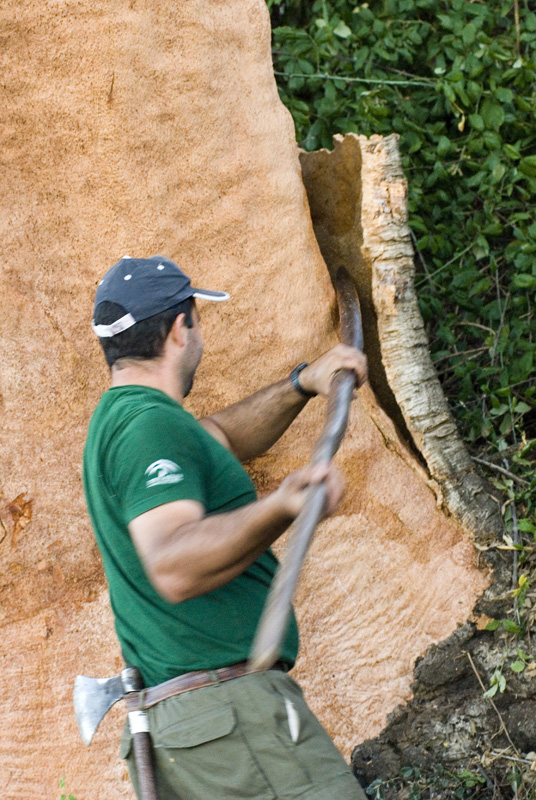
What is cork made of? Is it wood? Cork is the phellem layer of bark tissue that is harvested for commercial use as shown here in Spain. Made primarily from Quercus suber (the cork oak), cork is composed of suberin, a hydrophobic substance.
Is Cork endangered? Cork production is generally considered sustainable because the cork tree is not cut down to obtain cork; only the bark is stripped to harvest the cork.[5] The tree continues to live and grow. Cork Fun Facts: Cork trees can live for up to 300 years. At the age of twenty five, the tree’s bark can be harvested every nine years, for a period of over 200 years. While the cork is growing, it is capturing carbon dioxide from the atmosphere. But it gets more interesting…each time the cork is harvested, the tree absorbs more CO2 to aid in the bark regeneration process. This means regularly harvested cork trees store three to five times more CO2 than those left unharvested as seen here.
Where does cork come from? As of time of this publication approx. June, 2019) , there are about 2,200,000 hectares of cork forest worldwide; 34% in Portugal and 27% in Spain. Annual production is about 200,000 tons; 49.6% from Portugal, 30.5% from Spain, 5.8% from Morocco, 4.9% from Algeria, 3.5% from Tunisia, 3.1% Italy, and 2.6% from France.[3]
Are cork products water or liquid resistant/waterproof? Well…wine corks are made of cork, right? Cork has a magic chemical in its cell membrane that makes it completely impermeable to liquids and gases. This chemical is a mixture of fatty acids and heavy organic alcohol called suberin, which as well as rendering cork impermeable also stops it from rotting or degrading over time.
Is cork fire retardant? In its natural form, cork is also a very good fire retardant, although cork dust is actually extremely flammable (because here the cell structure has been broken down). Thanks to the thermal and weak combustion properties of cork, cork oaks are more fire-resistant than other trees. The slow combustion of cork makes it a natural fire retardant, forming a barrier against fires. It’s combustion does not release smoke or toxic gases. Some of cork’s other great properties: thermal and acoustic insulator, hypoallergenic, elastic and compressible, highly abrasion resistant, light (over 50% of it’s volume is air)


